
No Hancock County 72-Hour Feed
The Hancock County Sheriff's Office links an official current-and-past Inmate Inquiry. Neither the sheriff navigation nor the inquiry interface offers a button or query labeled “recent releases” or “72-hour releases.” The inquiry can locate booking details, but it cannot produce a verified, complete group based on the time each person left custody.
That boundary matters more across three days. A broad range can reveal more candidate bookings than a one-day check, yet it can also produce more current detainees. Meanwhile, someone admitted before the range can be released within it and never appear in the booking-date results. The wider window reduces some discovery gaps. It does not fix the mismatch between Booking Date and Release Date.
Review Hancock County 72-Hour Releases
A three-day review should be tied to exact calendar dates and the time the search is run. “Last 72 hours” is a moving interval, while the inquiry's Booking From and Booking To controls are date fields. Record the intended start and end before searching so the final statement does not silently shift.
- Open the official inquiry and enter a full name, subject number, or booking number when one is known.
- Set Booking From and Booking To across the three dates relevant to the review.
- Leave the In Custody box unchecked so both current and past inmate records may appear.
- Match identity with the subject number, birth date, booking number, physical details, and booking history.
- Open every relevant booking and read the actual Release Date and time, not only Scheduled Release Date.
- Keep only records whose actual release timestamps fall inside the defined interval, then review each disposition and court docket.
The result remains a person-by-person check. It is useful for confirming a candidate name and for comparing several known bookings. It does not discover an older booking solely because its release occurred during the chosen three days.
Note: The Hancock County 24-hour release check is narrower when the event likely occurred on the current date.
Hancock County 72-Hour Release Fields
The public inquiry separates discovery fields from verification fields. Search results can show a name and likely custody episode. The linked booking supplies the actual release entry. Blank fields occur, so no single empty cell should be used as proof.
| Field | Role in a three-day review |
|---|---|
| Name, photo, subject number | Helps distinguish people with similar names and connect several bookings. |
| Booking Date | Controls the public date-range discovery, but does not state when custody ended. |
| In Custody | “Yes” indicates current listed custody; a blank result still requires the booking detail. |
| Scheduled Release Date | Shows a prospective date or time that may change before processing is complete. |
| Actual Release Date | Provides the date and time the selected Hancock booking ended. |
| Disposition | Can show Bond/Bail Posted, Time Served, Warrant to Discharge, or another recorded outcome. |
| Court, docket, bond | Routes the reviewer to the underlying order and later case events. |
| Housing Facility | May name the Justice Center for current records and may be blank after release. |
Multiple Bookings is especially important across a wider range. One earlier booking can contain a release timestamp while a later booking remains active. The first event does not establish the person's present status. Select and describe the exact episode rather than treating a person-level result as one continuous stay.
Hancock County Weekend Release Checks
A 72-hour review is often chosen to bridge a weekend or a span of days when an exact event time is uncertain. Hancock County has not published a special weekend or holiday release rule, a routine processing schedule, or a guaranteed inquiry refresh interval. It would be inaccurate to say that all such releases appear on the next business day or within a fixed number of hours.
Use the three-day range to find likely bookings, then check for actual timestamps. If a Scheduled Release Date has passed but the record still says “In Custody: Yes,” check again and contact the jail when needed. A schedule can change because of a court order, another charge, a hold, a transport, a correction, or administrative work. It is not the time the web page must update or the time a person must exit.
Calendar boundaries can also hide a record. A person booked on Thursday and released Sunday falls outside a Friday-through-Sunday booking search, even though the release is within that interval. A records request based on release timestamps is the reliable way to resolve that gap.
Note: No official Hancock County weekend release schedule or web-update promise was found, so phone confirmation remains appropriate.
Hancock County Release Range Mismatch
Hancock County's distinctive data issue is simple but consequential: the public archive retains an exact Release Date and time in the detail, while the public search form filters by booking date. The inquiry is therefore strong for proving that one selected booking ended. It is not structured to export everyone whose release time falls within a rolling window.
False positives arise when the search returns a recent booking whose custody flag remains “Yes.” False negatives arise when an older booking ends during the target period but is excluded by Booking From. Expanding the search farther back can find more older admissions, but no known start date guarantees completeness because the historical retention period is unpublished.
The inquiry's update cadence is unpublished as well. Save the URL, access date, subject and booking identifiers, actual field label, and timestamp when documenting a result. If the visible data is unclear, the sheriff's record is a better basis than assumptions about delay or retention.
Request Hancock County Three-Day Releases
For a complete set, use the sheriff's NextRequest public-record portal or another channel listed by the records office. Ask for actual Justice Center releases between two exact timestamps. Include the start and end with the local time zone, and request the name, subject or booking number, actual release time, disposition or type, and receiving custodian when those fields exist and may be disclosed.
A release-based request is different from a request for all bookings across those dates. State the distinction. If the goal is a weekend span, define the interval rather than saying “the weekend,” which can be read several ways. The sheriff's official records guidance lists the available submission channels. A narrow request can also name one person and ask for the booking sheet, discharge entry, and release computation when the visible detail conflicts with a court record.
The sheriff accepts requests online, by phone, fax, email, mail, and in person. Records staff list 419-424-7251 and weekday office hours from 9:00 a.m. to 4:00 p.m. Published guidance says many records are available in three to five business days, but the actual response depends on the request and should not be guaranteed.
The Hancock County sheriff request portal is pictured below as the official completeness fallback for a three-day release interval.
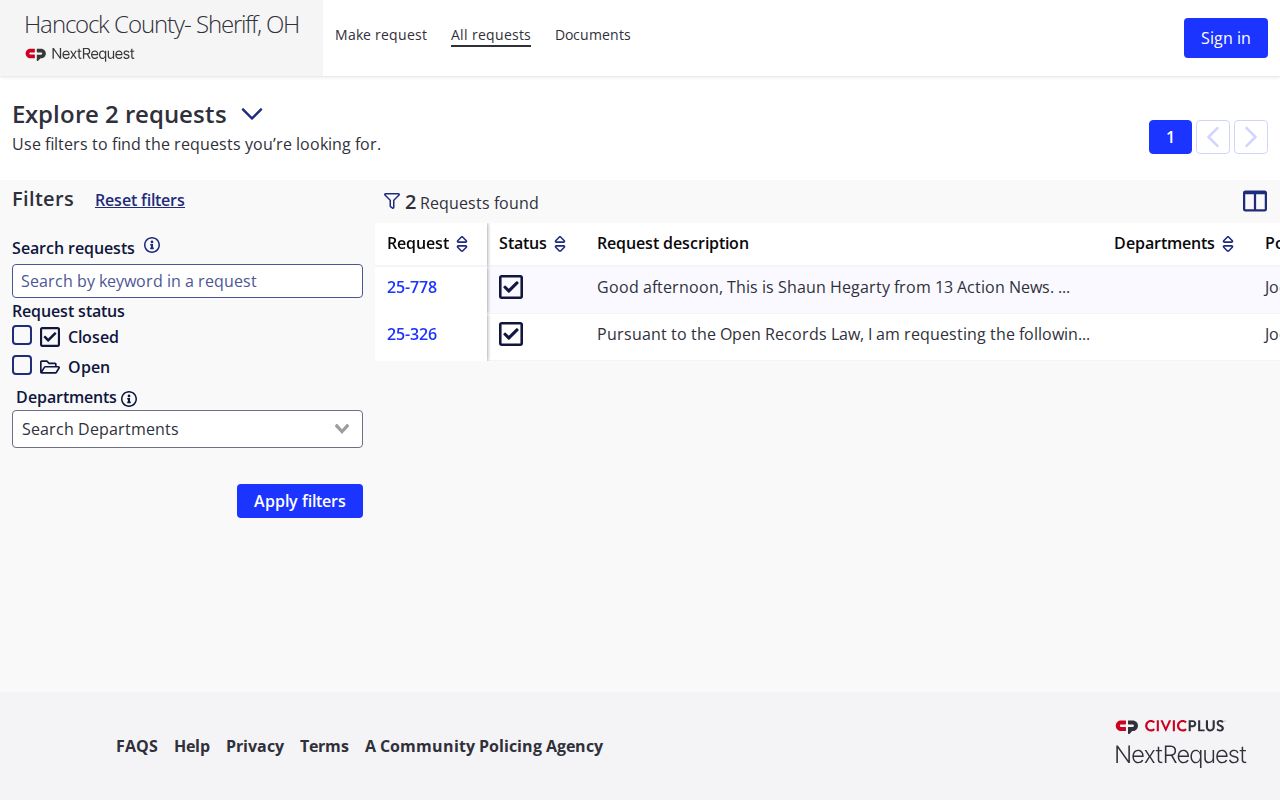
The portal provides a request route, while the wording of the request must specify releases rather than bookings.
Reconcile Hancock County Release Records
An actual release time ends one Hancock County Justice Center booking. It does not automatically answer what happened to every charge or where the person went next. “Bond/Bail Posted” can accompany an open case with later hearings. “Time Served” should be compared with the sentencing entry and jail-time credit. A Warrant to Discharge entry reflects the jail record and should be read with the court order.
A court dismissal and a jail release timestamp can also differ. One dismissed charge may leave another charge, warrant, sentence, or agency hold in force. Conversely, a person can leave jail before the court later dismisses a case. Check all bookings and charges instead of forcing two offices' timestamps to match.
For felony matters, use Hancock County Common Pleas records. Findlay and Fostoria Municipal courts handle their relevant matters. The official Hancock County CourtView search can provide a durable legal trail, but it is not the custody clock. If the court shows dismissal and the jail detail has no release time, ask the Justice Center for the release or present-custody record.
Route Hancock County Release Status
The 72-hour inquiry method covers Hancock County jail bookings. It does not cover an Ohio prison discharge simply because the sentence began in Hancock County. For state custody, search the Ohio Department of Rehabilitation and Correction by name or offender number and use County of Commitment=Hancock when helpful. Read Released and APA Supervision details carefully because state release can include supervision.
The sheriff's Hancock County VINE gateway is useful for alerts tied to a specific person and reporting agency. VINE is not a durable release archive, and a no-result proves nothing. A transfer alert is not the same event as community release. Pair any notice with the source custodian's record.
Federal prison releases belong in the BOP locator. ICE can show some people recently released from immigration custody for a limited period. The U.S. Marshals Service has no comparable public release locator. None of those systems should replace the county inquiry for an ordinary Justice Center booking.
Confirm a Hancock County Release
A defensible conclusion is narrow: the official Hancock booking record reports that a specific booking ended at the displayed actual date and time. Avoid turning that entry into claims that every charge ended, a sentence was complete, or the person went home. Those questions require the charge detail, court order, and any receiving-custody evidence.
If one known name is the real goal, use the Hancock County released-inmate lookup rather than trying to reconstruct a three-day cohort. Search custody without restriction, open the past detail, identify the right booking, and then follow the route indicated by the disposition. This method is more precise than relying on a date range alone.
Note: Date every status observation because a later booking, warrant, transfer, or court order can supersede an earlier release entry.