
Hancock County Projected and Actual Release
A scheduled or projected date points forward. An actual Release Date records the end of a specific custody episode. Hancock County Inmate Inquiry may show Scheduled Release Date on a current booking, sometimes with a time, while the booking detail can later show the actual Release Date and time. The public system does not state how fast it refreshes. A scheduled time cannot be treated as the moment the page changes or the person exits the Hancock County Justice Center.
A pretrial record needs special care. Before judgment, release often turns on bond, a court order, a hold, or completion of booking rather than a sentence calculation. Hancock County's Pretrial Release/Bond program may permit release from jail while the case awaits sentencing, with reporting or no-contact terms. That is real departure from physical custody, but it is not sentence completion. The current docket and an actual jail Release Date are the proper checks.
ODRC uses a different, compound label: Expected Release Date/Parole Eligibility Date. The ODRC field definitions say it can be a projected release date or a date pending parole consideration. Those are legally different. A definite term can point toward an expected end, while a legacy, life, or parole-eligible term may mark a Board review point. An indefinite sentence has minimum and maximum terms that must be read with the offenses and aggregate sentence.
Scheduled is not actual: A future date or parole eligibility field does not confirm release, community arrival, or the end of supervision.
The official ODRC definitions screen identifies the field meanings used in state records.
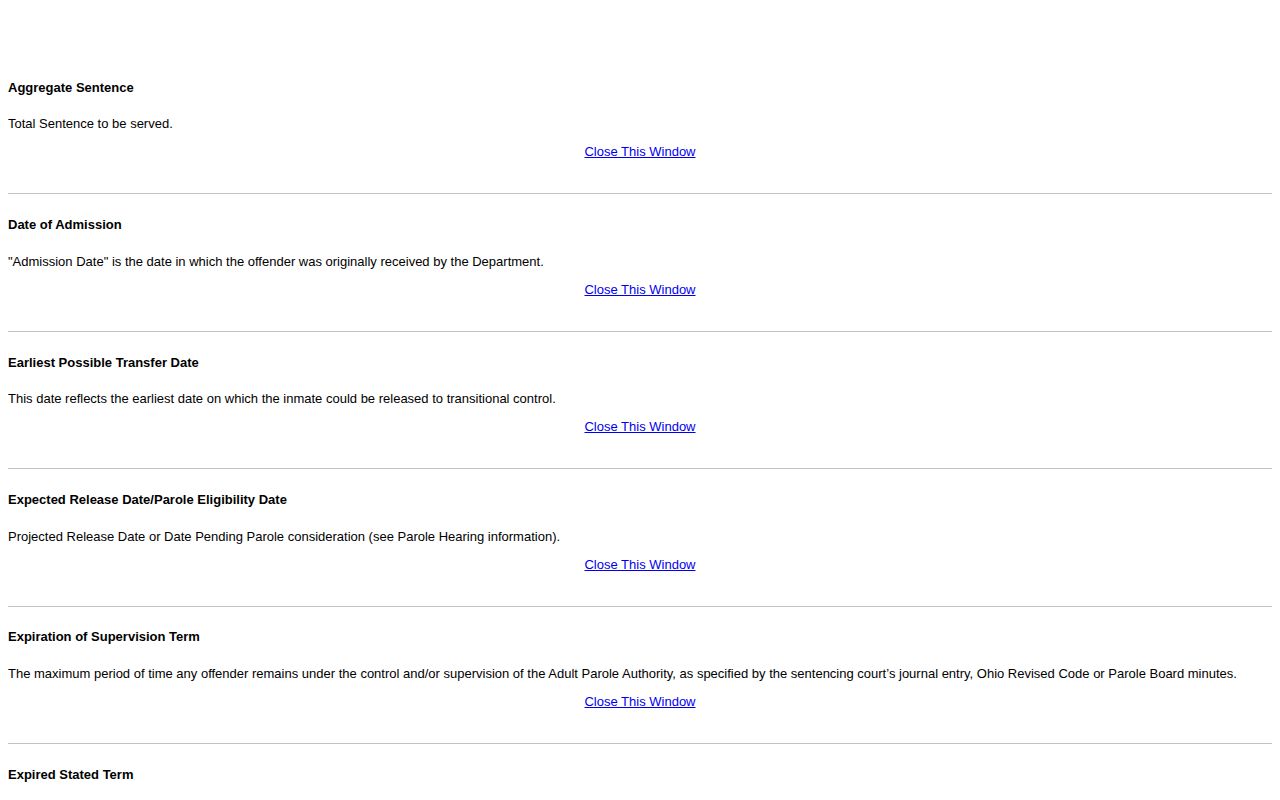
Use those definitions before interpreting a future date, transfer field, hearing month, or later parole detail.
Find Hancock County Projected Release Date
First determine the custodian. An ordinary Hancock County jail term is not computed in the ODRC portal unless the person was conveyed to state prison. A state sentence belongs in ODRC. A pending county case belongs in the jail record and court docket. The full Hancock County released-inmate search path can help identify a transfer before a date is interpreted.
- Match the person by full name, date of birth, subject or booking number, or ODRC number. Do not rely on a name alone.
- For the Hancock County Justice Center, open the correct booking history entry. Compare Scheduled Release Date with custody status and any later actual Release Date.
- Open the proper court case. Read the judgment, sentence, jail-time credit, bond order, and any later modification, hold, or warrant.
- For state prison, use the ODRC Offender Search. Search by name or number and use County of Commitment=Hancock when it fits.
- Read the exact Expected Release Date/Parole Eligibility Date label, aggregate sentence, offense details, status, and any next or latest Parole Board fields.
- Check again after the date. Confirm an actual county Release Date, ODRC status change, or Parole or Release Detail before saying custody ended.
If the Hancock booking does not explain the calculation, ask for the sentencing entry, commitment, jail-time-credit figure, sheriff release computation, and actual release entry. For an ODRC question, Central Records uses P.O. Box 430, Columbus, Ohio 43216, and the offender-search contact lists 614-752-1161. Request releasable date and status fields rather than a full supervision file.
The official ODRC example record shows how the compound expected-release and parole-eligibility field appears on a person detail.
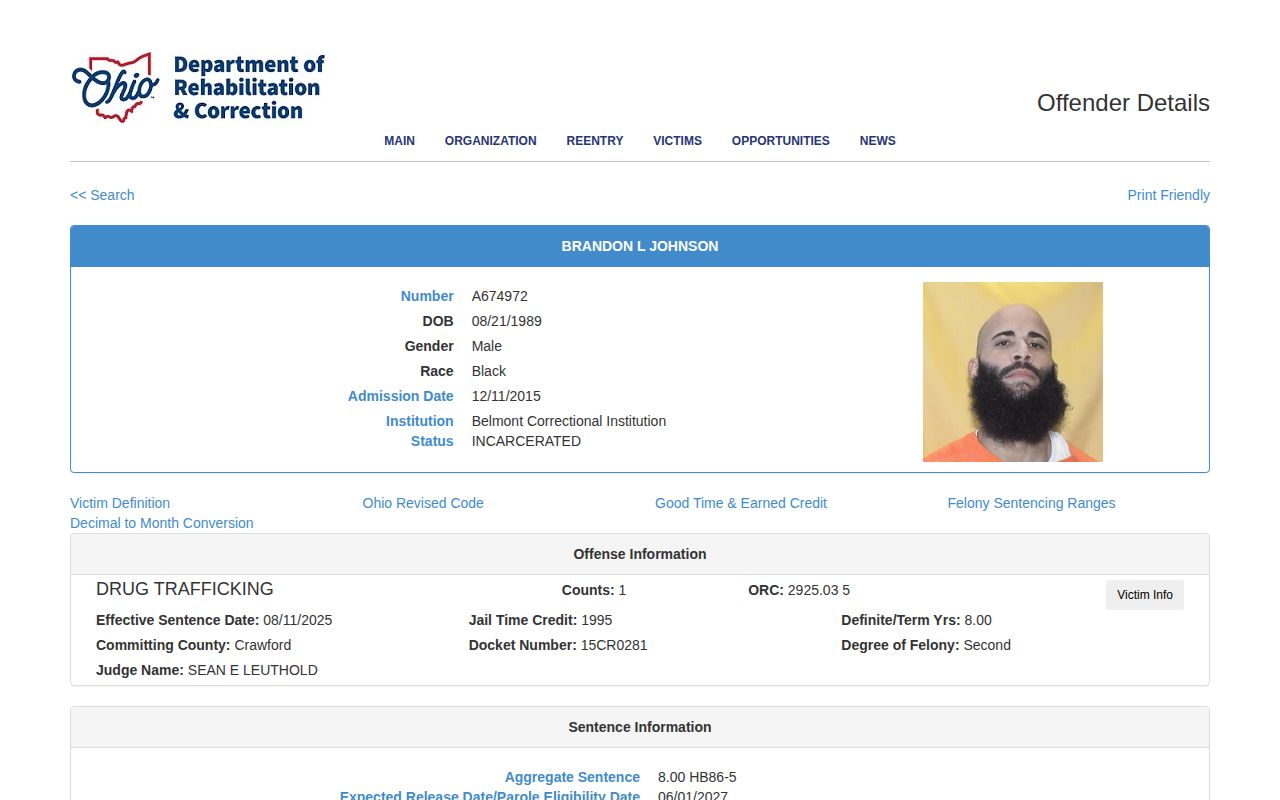
The record layout shows why the status, sentence, and release or parole detail must be read with the date.
Note: County of Commitment ties an ODRC sentence to Hancock County; it does not describe the person's current residence or current facility.
Ohio Credit for Hancock County Release
Ohio does not have a safe blanket rule that every state prisoner serves 85 percent. That phrase comes from subtracting a maximum 15 percent from an eligible term. It is not a promise. Many terms are excluded, mandatory portions remain fixed, some people do not earn the maximum, and provisional credit can be denied or withdrawn. Place that limit at the start of any estimate.
For confinement on or after April 4, 2024, ORC 2967.194 permits eligible prisoners provisionally to earn one or five days for each completed month of productive participation. It also provides possible extra monthly credit following program or activity completion and specified completion awards of 90 days or 10 percent of the stated term, whichever is less. The ordinary combined participation and completion credit is capped at 15 percent. Nonreducible terms, murder and aggravated-murder categories, life without parole, certain sex-offense terms, and other statutory groups are excluded.
Earlier accrual may involve ORC 2967.193 and transition rules. Related jail-time credit is governed by ORC 2967.191 for qualifying pretrial, examination, transport-wait, juvenile, and same-offense DRC confinement. A correction to that credit can move an expected date even when the prison term itself has not changed.
The official earned-credit statute page shows the detailed eligibility and award rules.
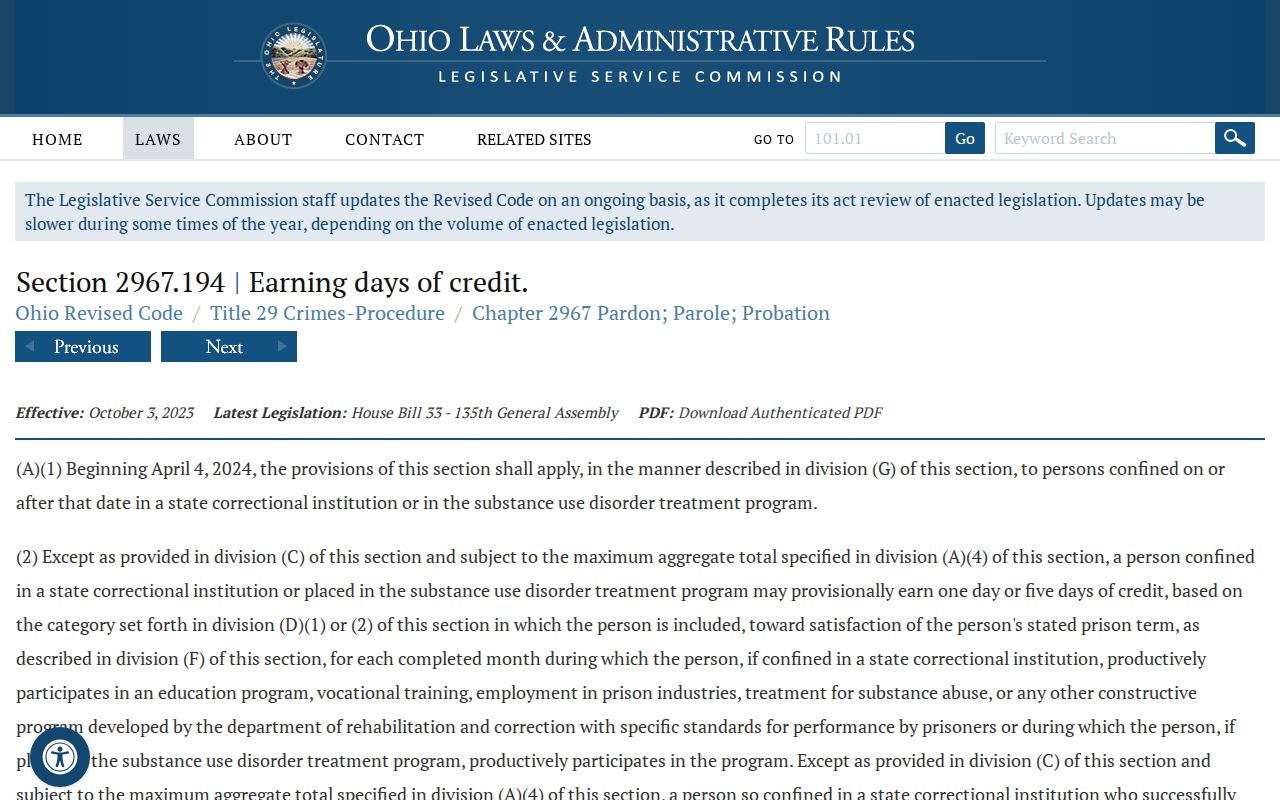
The statute's conditions and exclusions are why a simple percentage cannot replace an individual ODRC computation.
Why Hancock County Release Dates Change
A projected date is built from the sentence and the facts then known to the custodian. Later legal or administrative events can change the path. A date can move earlier, later, or stop functioning as a release estimate. The record should identify which system changed it.
| Factor | Possible effect | Record to check |
|---|---|---|
| Jail-time credit correction | Changes credited days against the term | Court entry and ODRC computation |
| Earned credit | May reduce an eligible term within statutory limits | ODRC detail and ORC 2967.194 |
| Credit denial or withdrawal | Can remove provisional days after rule violations | Current ODRC date and releasable decision data |
| Parole Board action | Can approve, deny, continue, rescind, or set another review | Person detail and public Board decision |
| Judicial release | May move a person to court-ordered community control | Court order under ORC 2929.20 |
| Hold, detainer, or new case | Can prevent community release or lead to another custodian | Docket, warrant, and receiving-custody record |
| Sentence correction | Changes the legal term or its structure | Amended judgment and updated ODRC record |
Transitional control is also distinct from final release. An Earliest Possible Transfer Date may mark possible movement, and a transitional-control sentence-expiration date can concern halfway-house placement. A Hancock County jail release followed by conveyance to ODRC likewise ends county custody but not confinement. The county Release Date and ODRC Admission Date can both be accurate for different systems.
Note: A detainer can end one custodian's episode without placing the person in the community, so follow the receiving agency.
Hancock County Jail Release Computation
Do not apply ODRC earned-credit percentages to a short Hancock County jail sentence. Local calculation begins with the court judgment, the sentence imposed, qualifying jail-time credit, the sheriff's computation, and any lawful county credit. The Hancock research sources did not publish a local good-time formula or weekend-release adjustment. That absence should remain explicit.
A jail detail may show Time Served, a sentence length, a disposition date, Scheduled Release Date, and eventually an exact Release Date. Compare those fields with the Findlay or Fostoria Municipal Court case or the Hancock Common Pleas judgment. Calendar days after sentencing may look shorter because credit was awarded for prior qualifying confinement. The arithmetic cannot be reconstructed from the booking page alone when the credited amount is missing.
A past booking can also end through a warrant to discharge, bond, or transfer. Those labels should not be forced into a sentence-end formula. Bond can leave future hearings and court conditions in place. A transfer may send the person to ODRC, another county, federal custody, or immigration custody. In each case, the Hancock County Release Date marks the end of that jail episode, while the receiving record answers whether confinement continued.
For a precise answer, request the commitment, judgment, jail-time-credit entry, sheriff computation, and release record tied to the correct booking number. The Hancock Sheriff's Records office accepts focused requests, and the NextRequest portal is available online. The office has not published a fixed fee or guaranteed turnaround for a jail release computation.
Hancock County Parole Eligibility Dates
Parole eligibility is a chance for Board consideration, not approval. ORC 2967.13 makes eligibility depend on the offense and sentence. ORC 2929.14 and ORC 2929.144 govern felony and indefinite structures. There is no one first-eligibility formula that safely fits every Hancock County commitment.
The ODRC search has a Next Parole Board Hearing Date filter in YYYYMM form. A detail can show the next review month and the latest hearing type and result. ODRC definitions state that cases are reviewed about two months before the displayed future date so a decision can be made first. A displayed month is not a day-by-day calendar, and a past date may describe the latest hearing.
Ohio Administrative Code 5120:1-1-10 governs hearing scheduling, continuances, and projected dates. A decision may approve release, deny it, continue review, send a matter to the full Board, or address transitional control. Even approval can remain subject to conditions, holds, rescission, and release processing.
Confirm Hancock County Release Date
Check the record again on or after the expected time. For Hancock County jail custody, look for the actual Release Date and review the disposition. For state prison, read the new ODRC status and any Parole or Release Detail. APA Supervision is positive evidence that prison custody ended under state supervision, but it is not final discharge.
Ohio VINE can provide a pending custody-change alert when registration was made while the person was in custody. The Hancock County VINELink inmate search process explains the alert route. A VINE general-release notice still needs the county booking record, ODRC detail, or docket to show what legal event occurred. A no-match is not proof of release.
Final check: Use the actual release field and current status after the projected date, then follow any transfer, hold, or supervision record.
If a scheduled Hancock County time passes without an update, contact the jail or submit a narrow records request. No public refresh cadence was found. Saving the exact label, identifier, source URL, and access date helps distinguish a stale estimate from an actual custody change.
A useful request names the person, birth date or subject number, and booking date, then asks for the scheduled date, actual release date and time, disposition, receiving agency if transferred, and the underlying computation when releasable. The sheriff reports that records are generally available several business days after an event, but that statement is not a promise about the web roster or a guaranteed response time.